




AURA 3D: at the BTX Bar, the real “battle” is the one you have with your digital twin
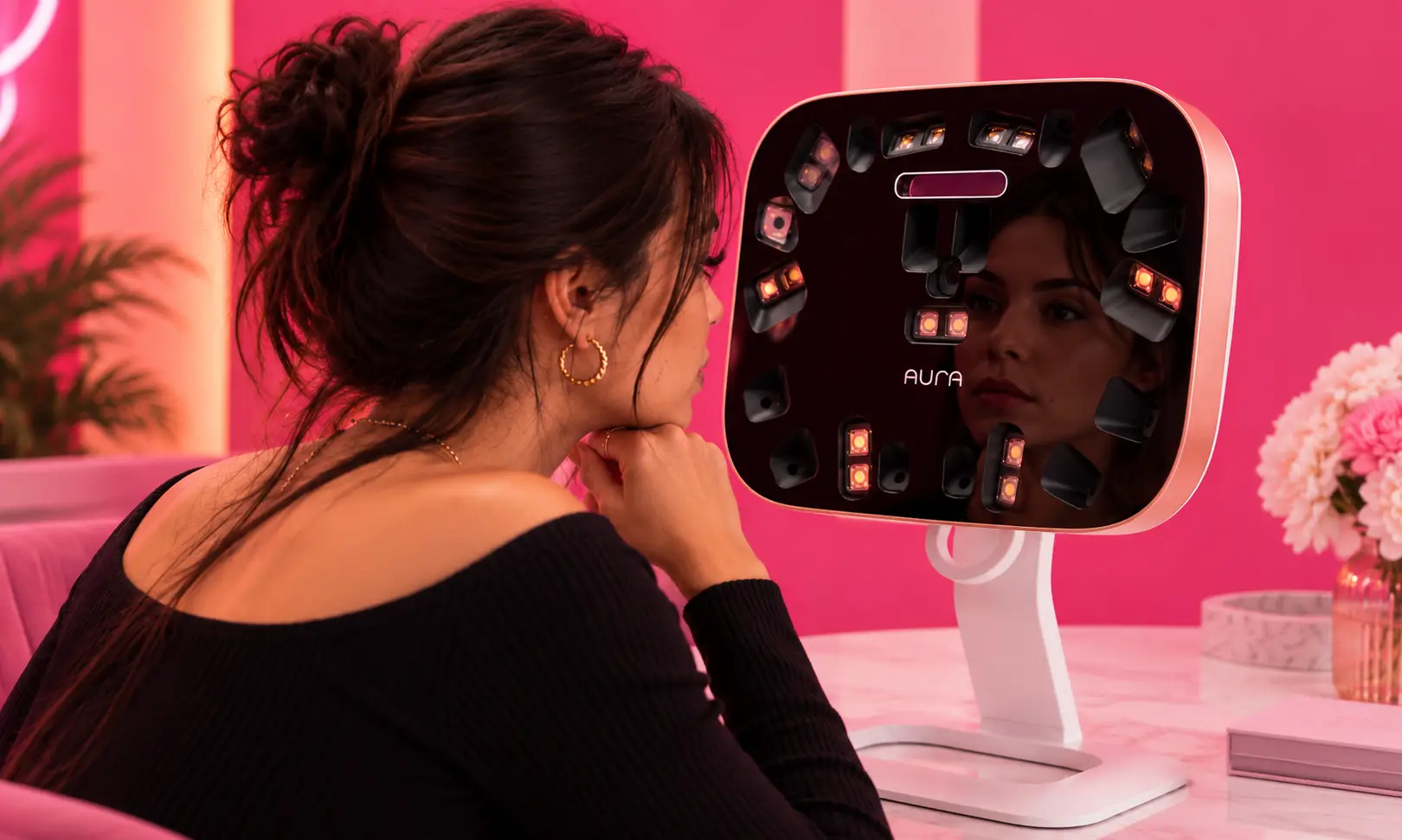
On social media, aura is earned through sheer charisma. In aesthetic medicine, however, AURA goes 3D: the BTX Bar in Milan has introduced a technology capable of creating a "digital twin" of your face and neck, analyzing skin characteristics and facial proportions, and simulating potential results before a treatment.
How many "aura points" do you have?
If you’ve never heard of Aura Battle, your algorithm probably hasn't dragged you into one of the most curious trends of 2026 yet. On social media, an intangible concept like charisma has become a sort of collective game: live contests where people challenge each other with poses, stares, movements, and self-confidence to determine who has the most "aura." The prize isn't a trophy, but something with even more "hype": attention, views, "aura points," and the chance to become a living meme.
Yet the word aura has a history that goes back much further than TikTok.
In philosophy, it refers to something that cannot be easily replicated: a presence, an unrepeatable character, what makes something—or someone— unique here and now. Walter Benjamin spoke of the aura of a work of art as its unrepeatable existence in the place and time where it is located.
And that is precisely the concept most closely aligned with our vision of aesthetic medicine.
At BTX Bar we believe that charisma is not a competition and that an aura does not need points. It is, rather, a matter of authenticity.
A face, much like a work of art, is unique in its space and time. It is not a static image: it changes as we live, telling the story of our age, our expressions, our habits, who we have been, and who we are becoming. Observing it today means capturing a here and now that will never be perfectly identical to what it was yesterday or what it will be tomorrow, let alone replicable.
AURA 3D Skin Analysis: from the mirror to the selfie, to the digital twin
With AURA 3D Skin Analysis, now available at the BTX Bar in Milan, every face—unique and unrepeatable—can be captured in three dimensions, observed in detail, and compared over time. A technology that creates a “digital twin” of the face and neck, adding something that until yesterday was much harder to obtain through any other professional representation and acquisition tool: a three-dimensional, standardized, and measurable representation of our “here and now.”
For decades, we have entrusted the perception of our face to the mirror. Then came the smartphone front camera, followed by filters, social networks, and algorithms capable of altering skin, volume, and proportions in seconds. Or even projecting us forward and backward in time at will.
The paradox is that, while we have an unprecedented amount of images of ourselves, we do not necessarily possess a more objective representation of our face. A two-dimensional photograph, in fact, can change considerably based on lighting, distance, perspective, head position, and the characteristics of the lens used.
3Dfacial imaging stems from a different principle: capturing the face under controlled conditions and transforming it into a three-dimensional model that can be observed, measured, and compared over time, enhancing the “clinical” eye of our aesthetic doctor.
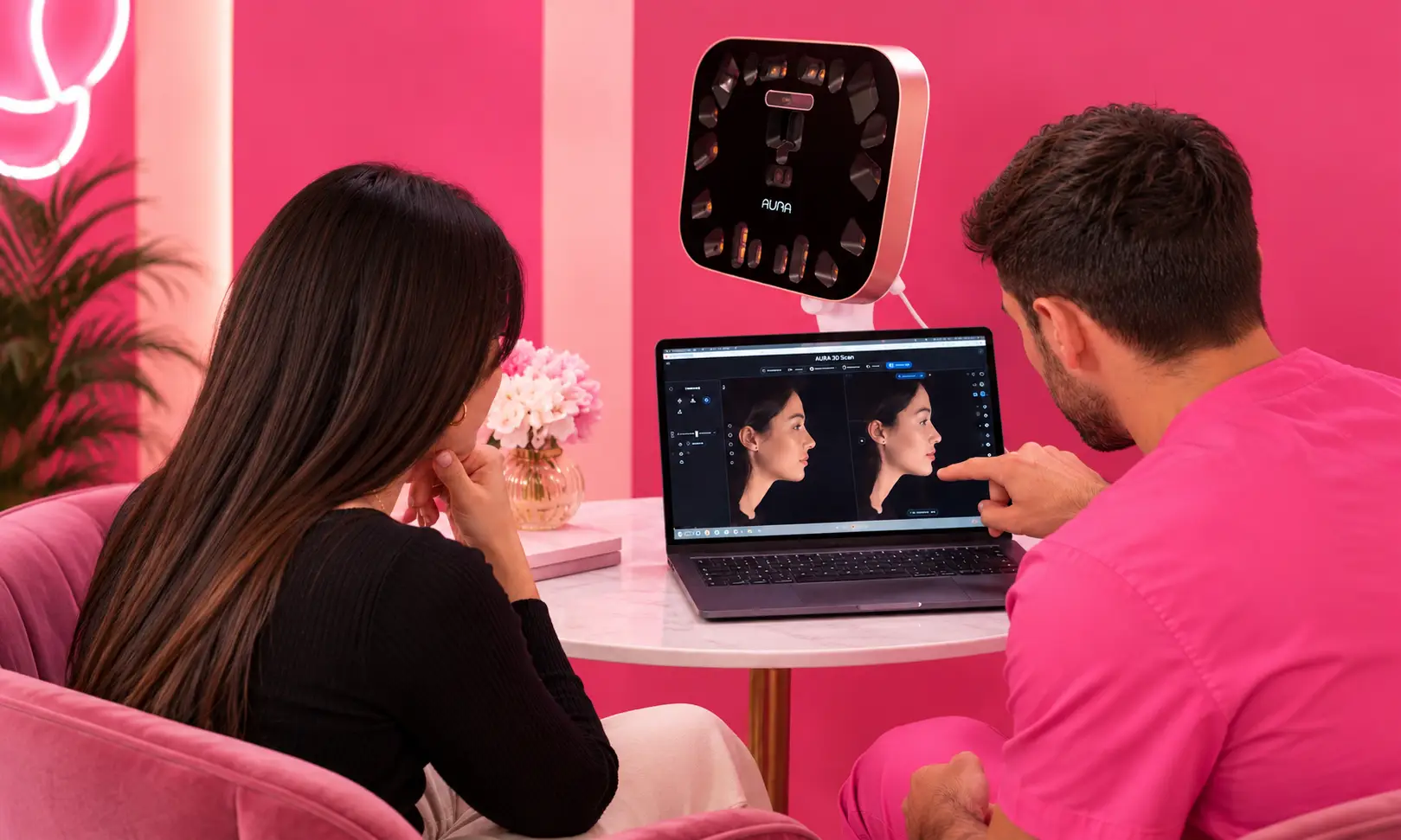
What is AURA 3D Skin Analysis and how does it work
AURA 3D Skin Analysis is an advanced facial imaging system that combines high-resolution photogrammetry, standardized lighting, and analysis algorithms.
The platform used at BTX Bar integrates 13 high-resolution cameras and 18 light modules equipped with polarized filters to capture the face and neck from different angles, reconstruct facial geometries and proportions, and observe features such as wrinkles and facial variations.
The scan is capable of reproducing a sort of three-dimensional digital twin of the patient, which allows the doctor to observe and compare skin and facial features, contrast scans taken over time, and simulate treatment results.
The system can analyze, among other parameters, wrinkles, texture, pores, and red and pigmented areas, in addition to allowing for measurements related to proportions, angles, distances, and volumetric changes.
Compared to traditional 2D photography, which can be affected by light, distance, angle, and subject positioning, standardized acquisition allows for three-dimensional images that are more easily comparable over time.
And it is precisely time that is one of the most interesting elements. By repeating the scan under the same conditions, the doctor can compare acquisitions made at different times and document some of the changes that occurred during an aesthetic medicine journey more objectively.
No longer just a "before and after," therefore, but a true three-dimensional follow-up.
From perception to data: simulation, AI, and follow-up
“I feel like this wrinkle used to be deeper.” “Did my face really look like that a year ago?” Anyone who has compared two of their own photographs knows how much perception can be influenced by lighting, expression, and even the memory we have of our own image.
AURA 3D adds to this perception standardized data and comparisons. The use of technology in monitoring wrinkles was also the subject of a study published in 2026 in the Journal of Cosmetic Dermatology, in which 3D acquisitions performed on 100 participants treated with botulinum toxin demonstrated the system's potential for an objective and reproducible assessment of changes over time.
Added to this is the possibility of creating simulations of potential aesthetic results, which are useful for exploring different approaches with your doctor before choosing a treatment plan.
However, please note: a simulation is not a guarantee of results. The human body is subject to many factors, and the response to a treatment depends on numerous individual variables.
Technology does not replace the doctor. It provides them with a new perspective
At BTX Bar, an AURA 3D scan takes about 3 minutes and can be included as part of a medical consultation lasting approximately 30-40 minutes, which for us at BTX Bar is the starting point for every treatment.
Three-dimensional acquisition represents only one part of the process: the doctor takes your medical history, interprets the information obtained, evaluates your individual characteristics, and integrates them into the definition of any potential treatment plan.
AURA 3D does not formulate diagnoses, does not decide which treatment to perform, and does not automatically transform a detected feature into a “defect” to be corrected. Artificial intelligence and imaging become tools to support clinical expertise, and the “digital twin” is not an avatar but a great ally for making the most of one’s own authenticity.